1. The Primeval & Spectral Landscape
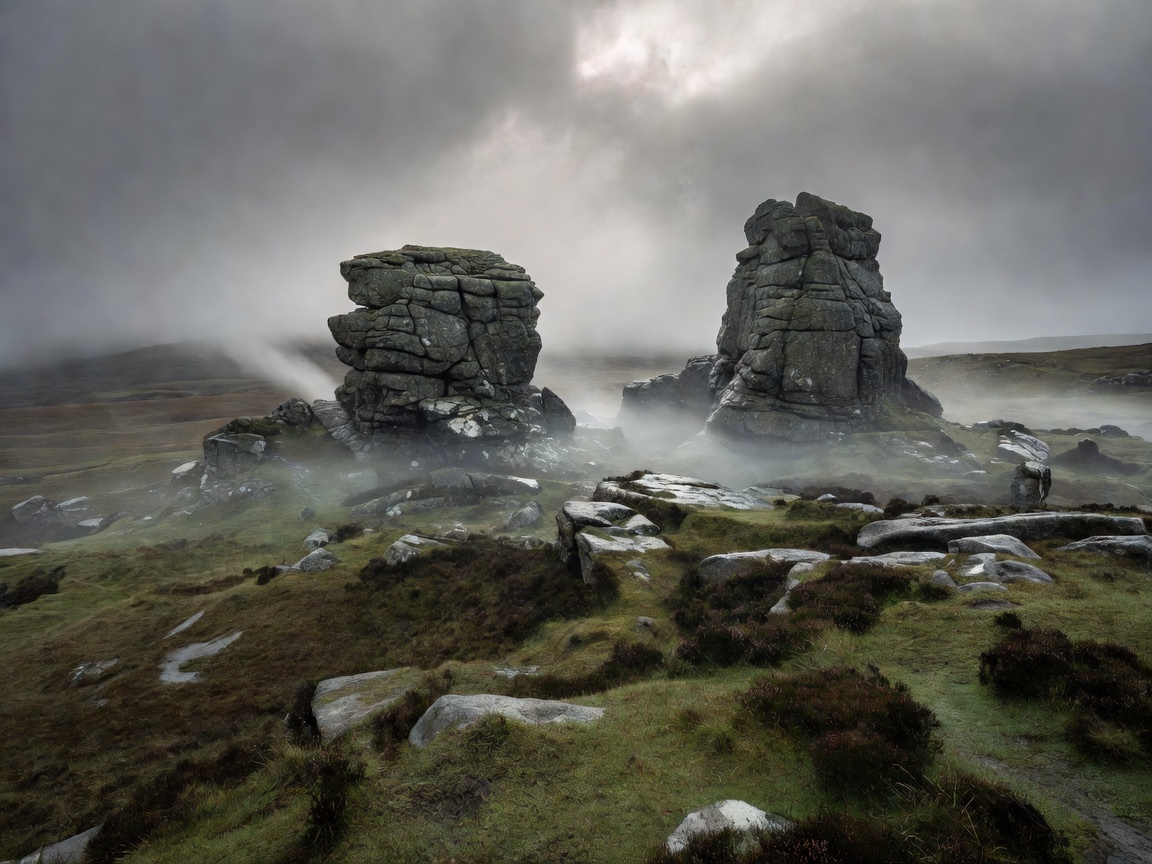
Dartmoor represents one of Britain’s most atmospherically dense wildernesses. Formed during the Carboniferous period nearly 300 million years ago, its granite heart is capped by sweeping blanket bogs, ancient clapper bridges, and monumental granite tors that rear out of the fog like fossilized giants.
When low-lying Atlantic moisture rolls across the plateau, visual markers vanish into uniform pearlescent mist. The acoustic spectrum drops to a hushed 28 decibels, broken only by trickling peat streams and the distant call of ravens across prehistoric stone circles.
2. Why This Place Awakens Archetypal Wonder
The Mysterious archetype taps into the human need for the uncanny, the sacred, and the unexplained:
- Megalithic Geometry: With over 1,000 recorded prehistoric stone alignments and burial cists, Dartmoor holds the densest Bronze Age archaeology in Northern Europe.
- Wistman's Wood: An ancient high-altitude temperate rainforest of stunted, moss-choked pedunculate oaks intertwined with granite clitter, untouched by timber harvesting for centuries.
- Topographical Disorientation: Navigating through sudden moorland mist dissolves modern spatial complacency, forcing total sensory presence and heightened somatic awareness.
3. Curated 3-Day Moorland Ghost-Path Cadence
An atmospheric, slow-foot journey across ancient ceremonial trails:
-
DAY 01
Haytor & the Granite Tramway
Ascend the twin granite stacks of Haytor at dusk; walk the 1820 stone-cut tramway into silent abandoned quarries.
-
DAY 02
Wistman’s Wood & Two Bridges
Early morning pilgrimage into the mossy labyrinth of Wistman’s Wood before sunlight burns away the valley mists.
-
DAY 03
Grimspound & the Scorhill Stone Circle
Traverse the perimeter of the 24-hut Bronze Age village and stand within Scorhill circle as night descends.